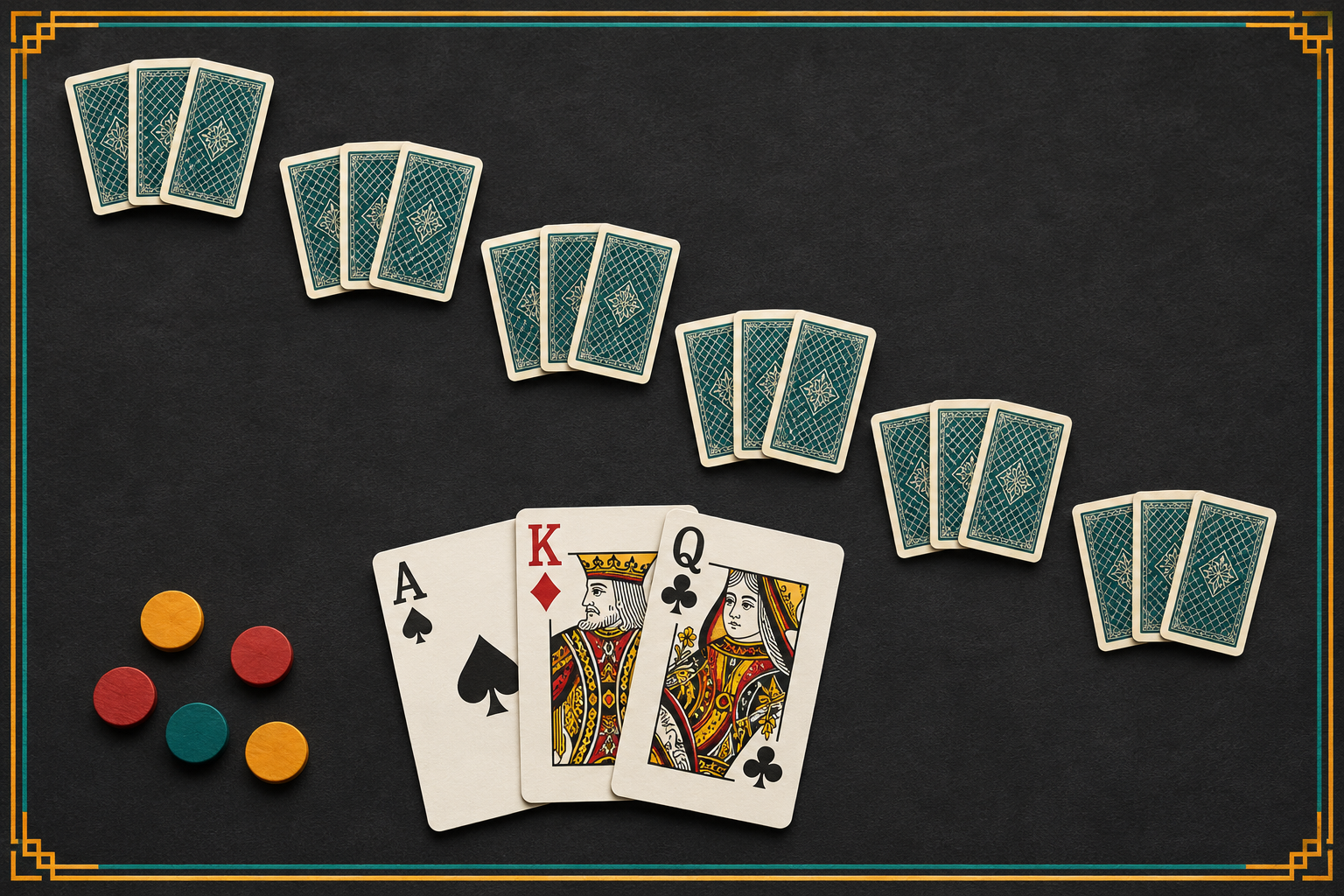
In short: the Teen Patti hand order is trail, pure sequence, sequence, colour, pair and high card. A higher category wins. Within the same category, compare the ranks specified below. Tables disagree on whether A-2-3 or A-K-Q is the highest sequence, so that rule must be announced before play.
This page covers hand order and probability. For the deal, blind and seen payments, side shows and the final show, start with the complete Teen Patti rules.
Teen Patti sequence chart
There are C(52,3) = 22,100 unordered three-card hands in a standard deck. The counts below treat A-2-3 and A-K-Q as valid sequences and reject 2-A-K.
| Order | Teen Patti hand | Example | Combinations | Probability | About 1 in |
|---|---|---|---|---|---|
| 1 | Trail or trio | 7♠ 7♥ 7♦ | 52 | 0.2353% | 425 |
| 2 | Pure sequence | 9♣ 10♣ J♣ | 48 | 0.2172% | 460 |
| 3 | Sequence | 4♠ 5♥ 6♦ | 720 | 3.2579% | 31 |
| 4 | Colour | A♣ J♣ 6♣ | 1,096 | 4.9593% | 20 |
| 5 | Pair | Q♠ Q♦ 7♥ | 3,744 | 16.9412% | 6 |
| 6 | High card | A♠ J♦ 7♣ | 16,440 | 74.3891% | 1.34 |
The probability and final columns are rounded for readability. For an exact value, divide the category’s combination count by 22,100.
1. Trail or trio
A trail contains three cards of one rank, such as A♠ A♥ A♦ or 4♣ 4♦ 4♥. Compare the rank of the trio: aces are highest and twos lowest.
There are 13 choices for rank and C(4,3) = 4 choices of suits, giving 52 trails. A trail is slightly more common than a pure sequence, yet standard Teen Patti ranks the trail first. Category order is a game rule and does not have to follow rarity.
2. Pure sequence
A pure sequence is three consecutive ranks in one suit. Examples include 4♥ 5♥ 6♥ and J♠ Q♠ K♠. There are 12 accepted rank patterns when both A-2-3 and Q-K-A are allowed, and four suits for each, giving 48 pure sequences.
The known rules difference is at the top. Pagat lists A-2-3 first, then A-K-Q, K-Q-J and downward. The Octro implementation lists A-K-Q first and A-2-3 second. Both place 4-3-2 at the bottom and reject 2-A-K.
If two players show the same pure sequence ranks in different suits, suits do not break the tie in the reference rules. At a final show, the player who did not request the show wins an exact tie. In an accepted side show, the requester packs when the two hands are equal.
3. Sequence or run
A sequence has consecutive ranks but is not all one suit. For example, 8♠ 9♦ 10♥ is a sequence. It loses to every pure sequence but beats every colour.
Each of the 12 rank patterns has 4³ = 64 suit assignments. Four are pure, leaving 60 mixed-suit assignments per pattern. That gives 12 × 60 = 720 sequences.
Use the same announced ace order as for a pure sequence. Do not rank A-2-3 one way in the pure category and another way in the mixed-suit category unless your house rule explicitly says so.
4. Colour
A colour is three cards of one suit that are not consecutive. A♣ J♣ 6♣ is a colour; 9♣ 10♣ J♣ is a pure sequence and belongs to the higher category.
Compare colours from the highest card downward. A-K-J beats A-Q-J because the aces tie and the king beats the queen. Suits normally have no order.
There are four suits and C(13,3) = 286 three-card choices within each suit. Subtract the 48 pure sequences: 4 × 286 - 48 = 1096 colours.
5. Pair
A pair has two cards of one rank and one card of another rank. Compare the pair first, then the odd card. K♠ K♦ 3♥ beats Q♠ Q♣ A♦ because kings beat queens. Q♠ Q♦ 9♥ beats Q♣ Q♥ 8♠ because the pairs tie and nine beats eight.
The count is 13 pair ranks × C(4,2) suit choices × 12 kicker ranks × 4 kicker suits = 3,744.
6. High card
A high-card hand has no pair, no sequence and no colour. Compare the highest card, then the second, then the third. A-J-7 beats A-10-9 because the aces tie and jack beats ten.
There are 16,440 high-card hands, found by subtracting the other five categories from 22,100. That is why a random three-card deal is high card almost three quarters of the time.
Three comparisons that cause mistakes
Lowest sequence versus highest colour
4♠ 3♥ 2♦ is a sequence. A♣ K♣ J♣ is a colour. The sequence wins because category comes before card rank.
Pair versus high cards
2♠ 2♦ 3♥ beats A♠ K♦ J♣. Any pair beats any high-card hand.
Same pair, different kicker
10♠ 10♦ A♥ beats 10♣ 10♥ K♠. After the pair ties, compare the odd card.
Why Teen Patti order is not poker order
Teen Patti uses exactly three private cards. Texas Hold’em builds the best five-card hand from seven available cards, and its hierarchy has categories such as full house and four of a kind that cannot exist in a three-card Teen Patti deal.
Do not copy a poker hand ranking chart into a Teen Patti show. The related guide Teen Patti vs poker explains the structural differences.
Probability method
The calculation partitions every possible three-card hand exactly once:
52 trails
+ 48 pure sequences
+ 720 sequences
+ 1,096 colours
+ 3,744 pairs
+ 16,440 high-card hands
= 22,100 total hands
Probability equals category combinations divided by 22,100. These are deal probabilities, not the chance that a category will win against a certain number of opponents. Winning probability also depends on how many other hands are dealt and on any folded information.
FAQ
What is the highest sequence in Teen Patti?
It depends on the version. A-2-3 is highest in the Pagat rules, while another widely used implementation ranks A-K-Q first and A-2-3 second.
Does suit break a tie?
Not in the reference rules. Compare category and ranks. At a final show, an exact tie goes to the player who did not request the show; in an accepted side show, the requester packs.
Is a trail rarer than a pure sequence?
No. There are 52 trails and 48 pure sequences. Trail still ranks higher because that is the standard game order.
Is 2-A-K a sequence?
No. Ace may connect below two or above king in an accepted pattern, but it cannot wrap around both ends.
Sources and data used
- Pagat: Teen Patti rules, checked 2026-11-23, for category order, tie-breaks and its A-2-3-high sequence version.
- Octro: Learn Teen Patti, checked 2026-11-23, for the alternative A-K-Q then A-2-3 order.
- Counts were derived by complete category enumeration from a standard 52-card deck. The six counts sum to C(52,3) = 22,100.
This content is for educational and entertainment purposes only.