When an all-in is called before all community cards are dealt, one run of the remaining cards can decide the whole pot. Some games let the players deal those cards twice, so each board awards part of the pot. Each separate set of remaining cards is called a runout. The option is called run it twice.
A turn all-in, dealt two ways
Picture a Texas Hold’em hand after the turn. The small blind and big blind have already posted their forced bets, and the players have acted in order around the table. Now all remaining betting is complete: Player A is all in, Player B has called, and the pot they can both win is 200 chips. The board is K♥ 8♠ 2♦ 9♣. Player A holds A♠ K♠; Player B holds Q♦ Q♣. Only the river remains.
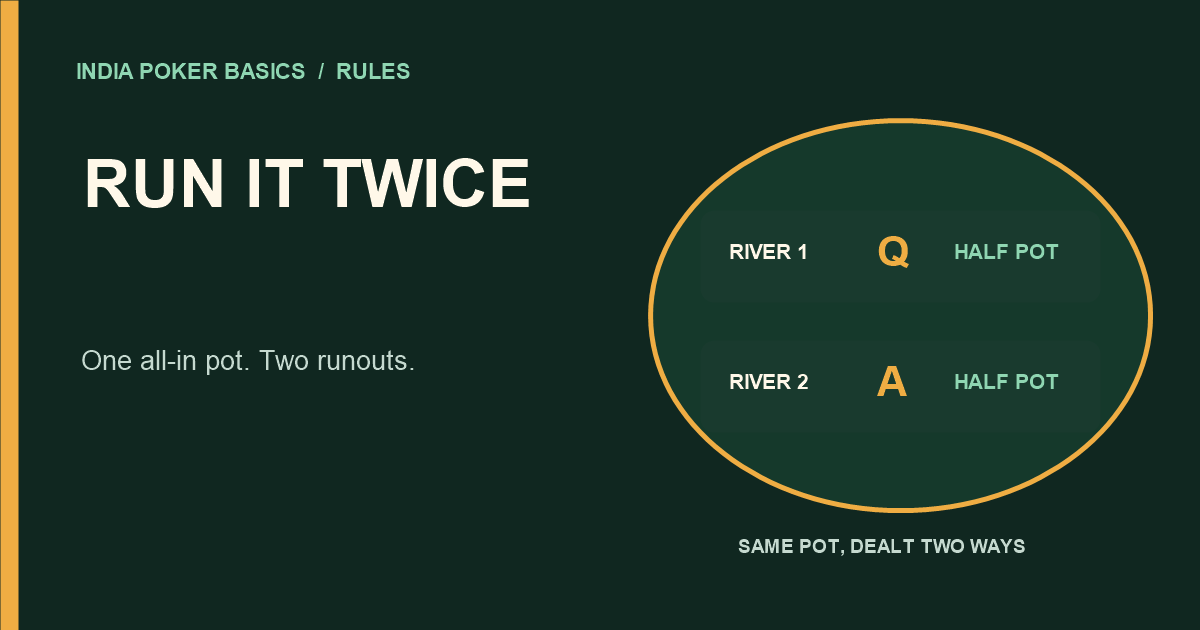
If the river is dealt once, one card decides who wins all 200 chips. If both players agree to run it twice and the game allows it, two different river cards are dealt from the remaining deck. The 200-chip pot is treated as two 100-chip portions:
| Runout | River | Result | Pot share |
|---|---|---|---|
| First | Q♠ | Player B makes three queens and wins this run | 100 chips |
| Second | A♦ | Player A makes two pair, aces and kings, and wins this run | 100 chips |
Each player receives 100 chips. That is the practical point of the option: a single river no longer decides the whole pot. If the same player wins both runouts, that player still receives the full pot. If a runout produces a tie, that runout’s share is split according to the normal hand-ranking and tie rules. For a refresher on comparing hands, see poker hand rankings and split pots.
The two rivers cannot be the same physical card. Once a card is used in the first runout, it is no longer available for the second. When the all-in happens before the flop, the remaining board is dealt twice; when it happens on the flop, the turn and river are dealt twice; when it happens on the turn, only the river is dealt twice. The original hole cards and any community cards already on the table stay the same for both runouts.
When can players run it twice?
The usual situation is an all-in that has been called, with no further betting action possible. The players who are still contesting the relevant pot must agree, and the table, event, or software must support the option. If someone does not agree, or the game does not offer it, the remaining cards are dealt once under the normal rules.
This is an agreement about how to deal the remaining cards, not a new bet. No one adds chips to get a second runout, and a player cannot use it to take back an all-in. The amount already in the pot and each player’s eligibility to win it stay the same. If a short stack is all in while deeper stacks have a side pot, only the players eligible for a particular pot can share that pot’s runouts. The all-in guide explains how main pots and side pots are separated.
The exact offer can vary. Some games may let players set a preference in advance; others ask at the table when the action is finished. Some games permit it only in certain formats or situations. Follow the rules shown for the game you are playing rather than assuming the option is always available.
Does running it twice change your odds?
Equity is a player’s expected share of the pot across all possible outcomes, including partial shares from ties. A hand with 80% equity does not necessarily win 80% of individual hands or receive 80% of the pot in every hand. Running it twice does not change the equity the players had when the all-in was called.
What changes is the swing in this one hand. With one runout, Player A either takes the whole pot or gets none. With two, Player A might win half while Player B wins the other half. Across comparable situations, the expected share of the pot remains based on the same cards and probabilities; the result is spread across two outcomes instead of hinging on one. Running it twice reduces the size of some individual wins and losses, but it cannot guarantee a split or prevent a player from losing the whole pot.
That distinction helps answer the common question, “Does it improve my chance of winning?” It does not improve the hand itself or make a poor call mathematically sound. It changes the distribution of this pot’s result. Make the call or fold decision first using the price, your hand, and the possible opponent hands; then decide whether you want multiple runouts if the game offers the choice.
For the probability calculation behind the same idea, see PokerCalcKit’s five-out run-it-twice example. This guide focuses on what players see at the table and how the pot is awarded.
What about a poker tournament?
“Run it twice” is most often discussed as an option after an all-in in a cash game. A tournament may use different rules. A format where every all-in automatically gets two runouts is a proposed tournament structure, not a rule you should assume applies to ordinary tournaments. A particular event could define a special format or a limited-use option, but the event rules would need to say so.
The idea also changes the rhythm of a tournament. If an all-in no longer eliminates a player whenever one runout goes against them, more players may remain in the event after those hands. Repeating boards also takes more time, especially with several players and side pots. Those are design trade-offs, not proof that the format is better or worse. For a specific event, check its published rules for whether multiple runouts are offered, who must agree, and how each pot is handled.
Quick answers
Does each player get half the pot when the board is run twice?
No. The pot is divided into portions for the runouts. Each portion goes to the winner of that board; one player can win both, each player can win one, or a tie can split a portion.
Can one player choose to run it twice alone?
Usually no. The players still contesting the pot must agree, and the game must allow it. If they do not all agree, the hand is dealt once under that game’s rules.
Is run it twice a standard tournament rule?
No universal tournament rule requires it. Treat it as a special format or option only when the event’s published rules provide for it.
Sources and scope
- PokerStars Help: What is Run It Twice?
- PokerNews: Running It Twice
- Poker Tournament Directors Association rules, for standard betting and pot procedures; run-it-twice availability depends on the game or event rules.
This content is for educational and entertainment purposes only.