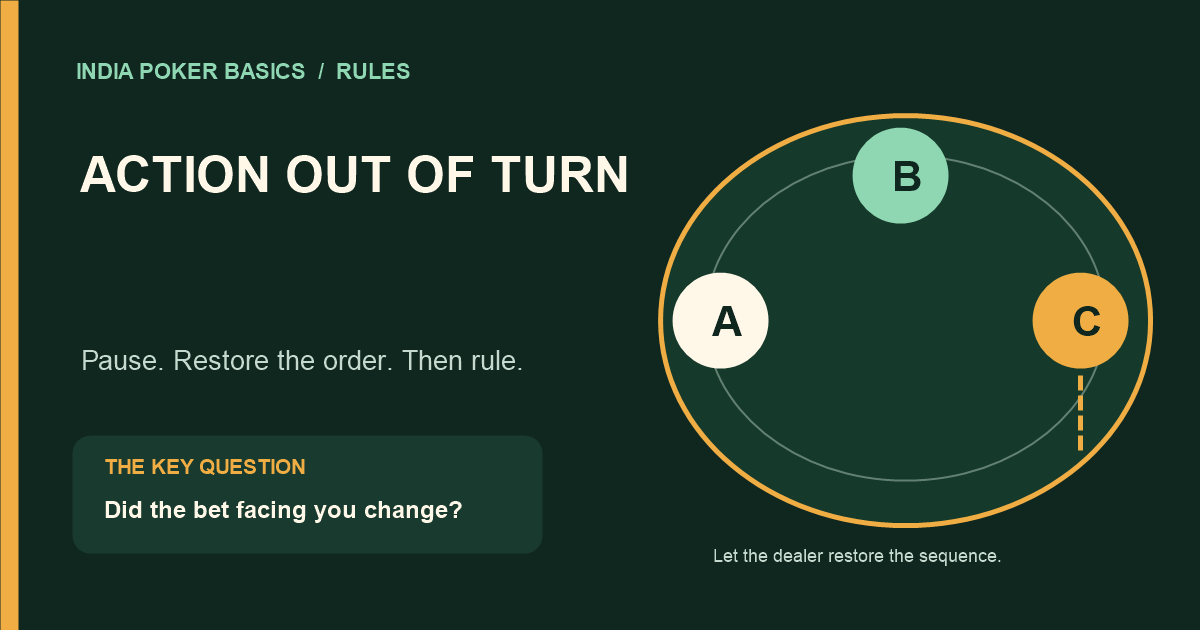
You are waiting to act when the player after you says “call” before you have checked, bet, or folded. That is action out of turn: a player has acted before the action legally reaches them.
The first step is to pause and let the dealer restore the correct order. Whether the early action is binding can depend on what you do and on the rules used by that game.
What counts as acting out of turn?
Checking, calling, raising, or folding before the player’s turn can all be out-of-turn actions. It often happens when someone misses a player who has not acted yet, or when a player assumes the action has reached them.
In normal Hold’em, preflop action begins to the left of the big blind. After the flop, the first active player to the left of the button acts first. If you need a refresher, see the Texas Hold’em rules reference and poker positions guide.
A simple example: the bet changes before your turn
There are three players still in the hand. Player A bets 100 chips. Player C, who is next after Player B, says “call” before Player B has acted.
The dealer should bring the action back to Player B. If B raises, the amount C faces has changed. Under the TDA tournament rule, C’s early call is not binding after that change; C gets the proper options when action reaches them. If B calls or folds instead, the amount C faces has not changed, so the early action may remain binding under that rule.
The important point is not to decide the ruling yourself while the hand is moving. Stop, identify the skipped player, and let the dealer restore the order.
The TDA tournament rule, in plain language
The current 2026 TDA Rule 55 says that in a multiway hand, an out-of-turn check, call, or raise is backed up to the correct player. If the bet amount facing the out-of-turn player changes before their turn, the early action is not binding; if it does not change, the action may be binding. An out-of-turn fold is binding under that rule.
Heads-up play has a separate provision: if one of the two remaining players checks out of turn, that player cannot raise if the other player then bets during that round. For a worked heads-up example, see this guide to what happens after an out-of-turn action. These are tournament rules, not a promise that every cash game or home game uses the same procedure. Ask the dealer or check the posted rules for the game you are in. See the official TDA rules for the full wording and current version.
What should you do if someone acts early?
- Do not act over the skipped player. Wait for the dealer to restore the correct order.
- Make your own action clear. A check, call, raise, or fold can affect whether the early action stands.
- Ask the dealer to explain the ruling before the hand continues if the next action is unclear.
Players are responsible for following the action and defending their right to act. If you notice that a player has been skipped, speak up promptly rather than waiting until several people have acted.
Does an out-of-turn call always count?
No. Under the TDA tournament rule, it may stand if the amount facing that player does not change. If an intervening player changes the bet, the out-of-turn call is generally not binding under that rule. Other games may use different house procedures.
Can a player take back an out-of-turn fold?
Under the TDA tournament rule, an out-of-turn fold is binding. Check the rules in force at the specific table, and call the dealer immediately if the action order was unclear.
This content is for educational and entertainment purposes only.