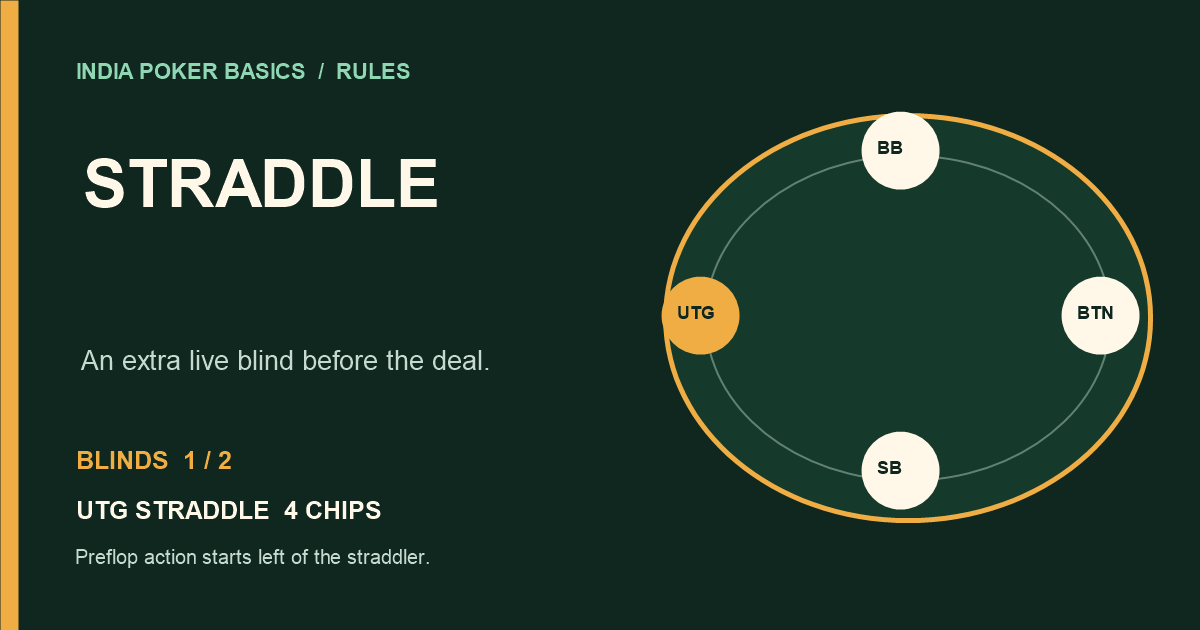
A player puts in an extra blind before receiving cards. The amount is larger than the big blind, and the player who posted it gets the last preflop option. That is the common under-the-gun (UTG) straddle in cash games that allow it.
The details are not universal. A straddle is an optional table rule, so check whether the game allows it, who may post it, and how much it must be before the hand starts.
What a straddle means
A straddle is a voluntary blind bet posted before the deal. In a common UTG version, the player immediately left of the big blind posts a live wager, often twice the big blind. It works like an extra blind for that hand, not like a normal raise made after seeing hole cards.
For example, with blinds of 1 and 2 chips, a permitted 4-chip UTG straddle is posted before the cards are dealt. The small blind still posts 1 and the big blind still posts 2. The straddle adds 4 chips to the opening pot.
“Twice the big blind” is a common example, not a universal amount. Some games do not allow a straddle. Others allow a button straddle, a Mississippi straddle, or more than one straddle under house rules. Tournament rules may differ from cash-game rules.
Who acts first after a straddle?
Without a straddle, preflop action starts with the first player to the left of the big blind. With a live UTG straddle, action commonly starts with the player to the straddler’s left and travels clockwise. If nobody raises, action returns to the straddler, who can check or raise.
Here is the sequence in a six-handed example:
- The small blind posts 1 chip and the big blind posts 2.
- UTG posts a live straddle of 4 before the deal.
- The first player to act is the seat left of UTG, not the seat left of the big blind.
- If every player calls the 4-chip amount, action returns to UTG for the final preflop decision.
The button and poker positions still determine the ordinary order after the flop. A straddle changes the preflop sequence for that hand; it does not move the button.
What does the straddle change?
The straddle creates a larger live amount to call before the flop. A player who has not posted a blind must usually put in the full straddle amount to continue, subject to the table’s rules. A raise is then measured from the current live bet and the game’s minimum-raise rule.
This affects the price of continuing and the amount already in the pot. It does not give the straddler a free option after someone raises: if action returns with a raise outstanding, the straddler must respond to that raise like any other player.
For the normal blind structure and action order, see poker blinds explained and the Texas Hold’em rules reference.
Before the hand, confirm these details
Ask the dealer or check the posted rules:
- Is straddling allowed in this game?
- Which seats may post one: UTG, the button, or another position?
- What is the required amount, and can another player straddle after it?
- Who acts first preflop, and does the straddler receive the last option if there is no raise?
Do not assume a rule from one room applies everywhere. The Poker Tournament Directors Association publishes tournament rules, while cash games and individual rooms may use their own posted procedures. The World Poker Federation’s poker terms guide also notes that straddle formats and action details can vary.
Frequently Asked Questions
Is a straddle the same as a raise?
No. A straddle is posted before the deal as a blind wager. A raise is an action taken during a betting round after the cards are dealt.
Does the straddler act last before the flop?
In the common UTG live-straddle setup, the straddler gets the last preflop option if action reaches them without a raise. Other straddle formats can use different positions and procedures.
Is a straddle required in every poker game?
No. It is optional and only applies where the game’s rules allow it. Confirm the local rule before the hand begins.
This content is for educational and entertainment purposes only.